

Types of meters you will see
| Type | How to spot it | Notes |
|---|---|---|
| Electromechanical | Spinning aluminium disc, number drum | Old type, being replaced |
| Electronic (static) | LCD display and a blinking red LED | Most common in homes today |
| Smart meter | LCD plus a communication module, often a SIM or RF | Reads remotely, can work prepaid or postpaid |
| Three-phase meter | Four input terminals, larger box | For three-phase homes, shops and small industries |
Karnataka ESCOMs, following the national push for smart metering, have started fitting smart meters, particularly for new and temporary connections. Check with your ESCOM (BESCOM, MESCOM, CESC, HESCOM or GESCOM) what applies to your connection when you apply.
How to read your meter
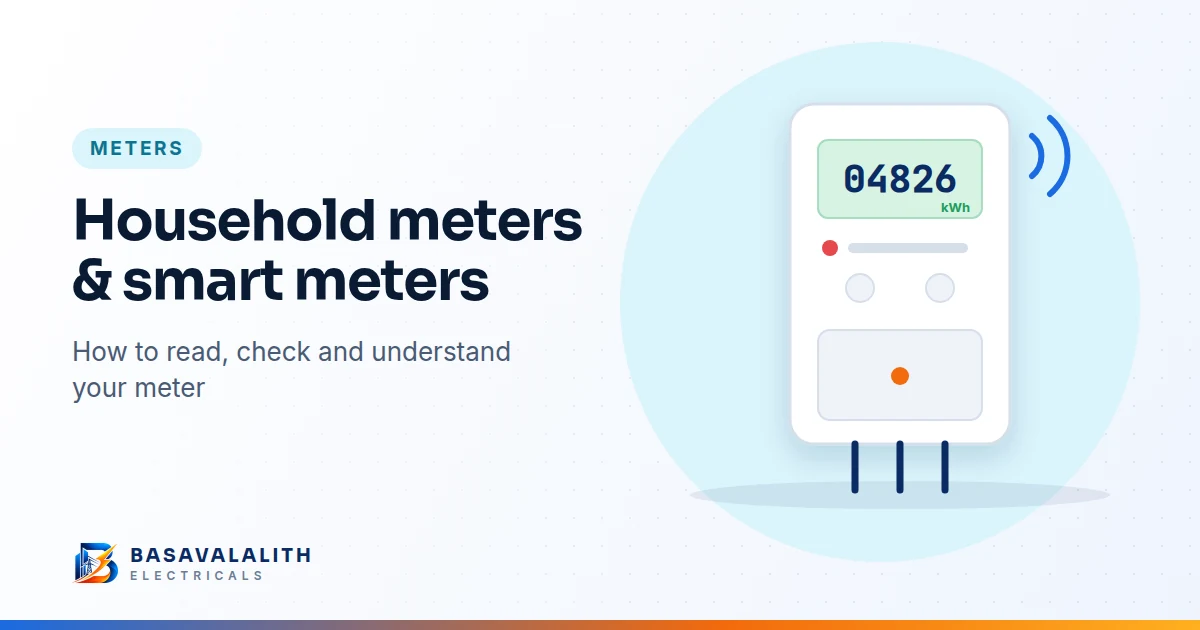
- The display scrolls through several readings. Wait for the one marked kWh. That cumulative number is what your bill uses.
- Note it down on the same day each month. This month's reading minus last month's reading is your consumption in units (1 unit = 1 kWh).
- MD (maximum demand) shows the highest load in kW recorded in a billing period. If it is higher than your sanctioned load, you may need load enhancement.
- Other screens can show voltage, current and power factor, which are useful when diagnosing problems.
Keep a weekly reading log
Reading the meter once a month tells you the bill. Reading it once a week tells you where the units go. Take a photo of the kWh screen on the same day and time each week and note it down:
| Date | kWh reading | Units since last | Units per day | What changed |
|---|---|---|---|---|
| 1 April | 4,872.6 | |||
| 8 April | 4,905.0 | 32.4 | 4.6 | Normal week |
| 15 April | 4,951.2 | 46.2 | 6.6 | AC used every night |
| 22 April | 4,999.8 | 48.6 | 6.9 | Guests, extra geyser use |
Multiply units per day by 30 for a monthly estimate. At 4.6 units a day this house uses about 140 units a month; at 6.9 a day it would use about 207. For a Gruha Jyothi home that is the difference between a zero bill and a full one, so the log gives you time to cut back before the reading date. It is also the best evidence you can have if you ever dispute a bill. Our bill calculator turns the units into rupees.
The MD screen matters in the same way. If your maximum demand regularly goes past the sanctioned load, plan the change before the ESCOM finds it. Loads above 5 kW usually need a three-phase service: see single-phase or three-phase.
Is my meter running fast? A simple home test
The red LED blinks a fixed number of times for every unit, printed on the meter as imp/kWh (for example 3200 imp/kWh). You can use it to check the meter yourself.
- 1Switch off every load but keep the main switch on
Watch the LED for five minutes. It should not blink continuously.
- ?Still blinking with everything off?Yes Possible leakage in wiring or a meter fault. Call an electrician.No Go to the next check
- 3Switch on one known load
For example a 1000 W heater. At 3200 imp/kWh, 1 kW should give about 53 blinks a minute.
- 4Count blinks for one minute and compare
A small difference is normal. A large, repeatable difference is worth a formal test.
- ✓Apply to the ESCOM for a meter test
The ESCOM tests the meter, with a check meter on site or in the lab, as per the Supply Code.
The formal meter test: what to expect
If your home test points to a problem, apply in writing at the subdivision for a meter test, with the account ID, the meter serial number and the reason. Pay the testing fee and keep the receipt. The ESCOM's meter testing staff check the meter either on site against a reference meter or by taking it to the lab.
- Ask to be present and to get a signed copy of the result.
- Before you apply, rule out leakage in your own wiring. If the LED keeps blinking with all loads off, the meter may be recording real leakage, and the test will show the meter is fine.
- If the meter is found fast or faulty, it is replaced and past bills are revised as per the KERC conditions of supply. Ask how many months will be revised.
- If you disagree with the result, you can ask for testing at an approved third-party lab.
The time limits, fees and the full complaint route up to the Ombudsman are in our high bill complaint guide.
Understanding your electricity bill
- Account ID / RR number: identifies your installation
- Previous and present readings: the difference is the units billed
- Fixed charges: based on sanctioned load
- Energy charges: based on units consumed and the KERC tariff
- Tax and other charges: as notified
- Gruha Jyothi: entitled units and any excess, for registered domestic consumers. See our Gruha Jyothi guide.
Burnt, stuck or faulty meters
- Burnt meter: usually loose terminal connections or load above the meter's rating. Do not try to repair it. Report to the ESCOM, which replaces the meter; charges may apply depending on the cause.
- Display blank or stuck: report it. Bills are assessed as per the Supply Code until the meter is replaced.
- Seal broken: report it immediately. Tampered seals can lead to penalties even if you did not do it.
- Meter shifting: needs an application to the ESCOM. Do not move the meter yourself.
Seals, tampering and buying a house
The meter and its terminal cover carry the ESCOM's seals. A broken or missing seal is treated seriously, because tampering to slow a meter or bypassing it is theft of electricity under Section 135 of the Electricity Act, 2003. The ESCOM's vigilance squads inspect meters, and the burden of explaining a broken seal falls on whoever is the consumer at the time.
- Never let anyone "adjust" the meter to reduce the bill, whatever they claim. Apart from the legal risk, a meter opened by an outsider is a fire risk.
- Report a broken seal in writing as soon as you notice it, with a photo, and keep the acknowledgement. A report made by you before any inspection is your best protection.
- Buying or renting a house? Look at the meter seals before you take possession, and get any problem recorded by the subdivision before you apply for name transfer. Once the account is in your name, the meter is your responsibility.
- Wires that bypass the meter, such as an extra cable from the service line straight to a pump or a shop, must be removed by a licensed electrician before anything else is done.
Faulty and stuck meters also have KERC time limits for inspection and replacement. Our post on ESCOM delay compensation lists them and explains how to claim when the ESCOM is late.
Smart and prepaid meters
A smart meter sends readings to the ESCOM automatically, so there are no estimated bills or missed readings. In prepaid mode, you recharge like a mobile phone and see your balance and daily use in the app. You get alerts before your balance runs out.
- Check your consumption daily and spot high-use days early.
- Supply may be disconnected when balance runs out, subject to grace rules, so set up reminders.
- Keep the meter's network module area clear. Do not enclose it in a sealed metal box.
Smart meters in Karnataka: where things stand
BESCOM made smart meters mandatory for new and temporary connections in urban areas from 15 February 2025 and in rural areas from 1 July 2025. The meters are at the consumer's cost; the prices quoted in BESCOM areas in 2025 were ₹4,998 for single-phase and ₹8,880 for three-phase. In April 2025 the Karnataka High Court passed an interim order stopping BESCOM from making smart meters compulsory for permanent connections, and BESCOM told the court they were not mandatory for existing consumers. Temporary connections are a different case: the tariff order says temporary supply is to be given through a prepaid meter.
The other ESCOMs have their own rollout plans. In practice:
- Existing home: you do not need to replace a working meter on your own. If the ESCOM proposes a replacement, ask in writing whether there is any charge.
- New connection: ask the subdivision on the day you apply what meter is required and what it costs, and budget for it.
- Rooftop solar: the generation and bidirectional meters for net metering have to be smart meters, at your cost. See our net metering guide.
- Prepaid smart meter: you recharge instead of paying a monthly bill. Our guide to paying online covers the ESCOM apps used for recharge.
A good meter board at home
Most meter faults we see start at a poor meter board. Mount it at an accessible height, away from rain and direct sun, with a proper cut-out or isolator, a correctly sized service cable and tight lugs. Leave space for extra meters if you may rent out a portion later.
Government schemes and ESCOM rules are revised from time to time. This article explains how things work in practice. Before you act, confirm the current rule on the Seva Sindhu portal, your ESCOM website, your subdivision office or the helpline 1912.
Meter board checklist
A separate meter for each rented portion keeps billing and Gruha Jyothi clean. See separate meters for a rented portion. The protective devices after the meter, the RCCB and MCBs, matter as much as the meter board itself.
Questions
How do I calculate units from my meter?
Subtract last month's kWh reading from this month's. The difference is your consumption in units, since 1 unit is 1 kWh.
Can I ask the ESCOM to test my meter?
Yes. You can apply for a meter test at your subdivision. A testing fee may apply, and the procedure follows the KERC Supply Code.
Who pays for a burnt meter?
It depends on the cause. If the meter failed on its own, the ESCOM replaces it. If it burnt because of excess load or a fault on the consumer side, charges may apply.
Is a smart meter mandatory?
Karnataka ESCOMs have started fitting smart meters, especially for new and temporary connections. Ask your ESCOM what applies when you apply for a connection.
Why does my new meter show more units than the old one?
Old meters, especially electromechanical ones, can run slow as they age. A new meter that reads correctly then shows higher units. Use the LED test to check the new meter before you complain.
What should I do if I find a broken meter seal?
Report it in writing to the subdivision with a photo and keep the acknowledgement. Do not wait for an inspection, because a broken seal can be treated as tampering.
Do I have to replace my working meter with a smart meter?
In BESCOM areas the High Court stayed the mandate for permanent connections in 2025, and BESCOM said smart meters were not mandatory for existing consumers. Ask your ESCOM in writing about any proposed replacement and its cost.
Need this done for you?
We handle the electrical work and the ESCOM, KPTCL and CEIG liaisoning anywhere in Karnataka, with BESCOM, MESCOM, CESC, HESCOM and GESCOM. Email basavalalith.electricals@gmail.com or use the enquiry form.
Request a site visit