

Know which line it is
| Line | How to recognise it | Owner |
|---|---|---|
| LT (415 / 230 V) | Several wires or a black bundled (AB) cable on short poles, connecting to houses | Your ESCOM (BESCOM, MESCOM, CESC, HESCOM or GESCOM) |
| 11 kV HT | Three bare wires on insulators, on taller poles; no service wires to houses | ESCOM |
| 33 kV HT | Larger insulators, taller poles or small towers | ESCOM |
| 66 kV and above | Steel lattice towers, long insulator strings | KPTCL |
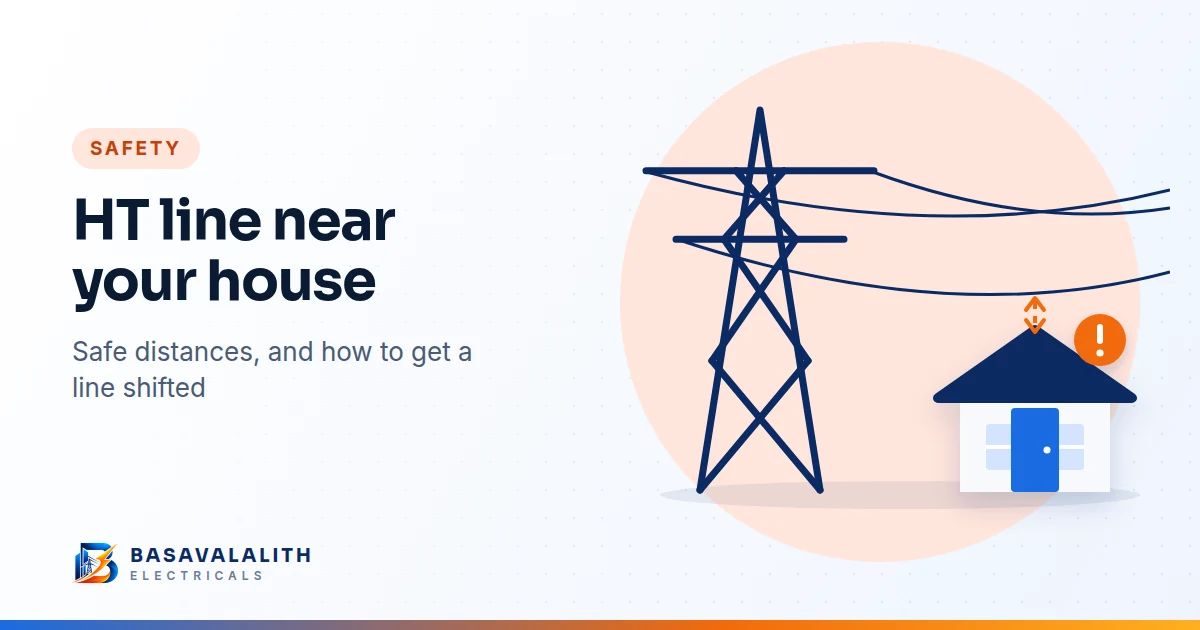
HT electricity can jump across air to a rod, pipe or person that comes close. You do not have to touch the wire to be electrocuted.
How people actually get hurt near HT lines
Very few HT accidents involve someone deliberately touching a wire. Almost all happen because something long or tall comes too close while people are busy with ordinary work:
- Iron rods on a terrace during slab or column work, lifted upright and swung near a line.
- Aluminium ladders and long pipes used by painters, plumbers and people cleaning overhead tanks.
- Lorries loaded high with sugarcane, hay or areca, harvesters and tall idols on trucks, driving under a sagging line.
- Flagpoles, decorations, antennas and cable wires thrown over or tied near a line.
- Children on terraces retrieving kites or balls from wires, especially in houses built too close to a line.
- Wet weather. Rain and humidity make flashover more likely, and sagging lines hang lower in summer heat.
An HT shock usually causes deep burns or death, and survivors often lose limbs. If an accident happens on an ESCOM line, the family can claim under the KERC regulations; see electrical accident compensation. Far better is to keep the line and the building apart in the first place.
Clearance: how close is too close
The Central Electricity Authority (Measures relating to Safety and Electric Supply) Regulations, 2023 set minimum vertical and horizontal clearances between lines and buildings. The required distance increases with voltage. Local building bye-laws and layout approvals also leave corridors under lines. Before buying a plot or planning a floor addition, get the clearance checked on site.
- Do not build under a line or within the clearance zone, including balconies, sunshades, staircases and rooftop sheds.
- Do not handle iron rods, aluminium ladders or long pipes near lines during construction.
- Do not let trees grow into lines. Ask the ESCOM to trim them; do not do it yourself.
Before you buy a plot or plan another floor
The cheapest time to deal with an HT line is before you pay for the land. Once you have bought a plot with a line across it, every option costs money and time.
Revenue sites and converted farm plots often have 11 kV lines running across them, because the line came first and the plots later. In a planned layout the developer should route the lines along roads; see layout electrification and DTCs. A building drawn without regard to the line can run into trouble later, at plan approval, when you apply for the permanent connection, or with the Electrical Inspectorate for a taller building.
Getting a line shifted
The ESCOM can shift a line or pole if there is a feasible alternate route. The applicant usually pays the cost of shifting.
- 1Written application to the ESCOM subdivision
Include the sketch of your plot, the line, and the proposed new route. Attach ownership documents.
- 2Site inspection
ESCOM engineers check feasibility, alternate route, and neighbours' plots.
- ?Is an alternate route feasible?Yes Estimate is preparedNo Request rejected, or a different solution such as underground cable
- 4Pay the estimate
Covers materials, labour and supervision.
- 5Shifting work
Done by the ESCOM, or by a licensed contractor under ESCOM supervision, during a planned shutdown.
- ✓Line recharged on the new route
Consent from neighbours may be needed if the new route passes over their land.
What to prepare for a shifting application
A clear application gets a faster site visit and a realistic estimate. Attach:
- Ownership documents: sale deed and the property record (e-khata, khata or e-swathu).
- A sketch of the plot with measurements, showing the existing line and poles, your building (existing or planned) and the route you are proposing.
- Photos of the line from the plot and from the road.
- Written consent of neighbours if the new route crosses or runs along their land.
- The sanctioned building plan, if the shifting is needed for construction.
What drives the cost. The estimate covers materials, labour and supervision. It goes up with the number of poles moved, the length of new line, whether it is an LT or an HT line, the conductor or cable used, and any road-cutting permission needed for an underground route. Moving one pole a few metres along the same road is a small job; re-routing an 11 kV line around a corner, or putting it underground, is a much bigger one. Ask for the estimate in writing and read what it includes.
Self-execution. Where the ESCOM allows it, you can pay a supervision charge and have the work done by a licensed contractor to the ESCOM's estimate and standards, then hand it over. For 11 kV and 33 kV lines the contractor needs a Class 1 or Super Grade licence; see electrical contractor licence classes. The same approach is used for apartment transformers, described in power for apartments and multi-storey buildings.
Can the line go underground?
Converting an overhead stretch to underground cable is possible in many cases, especially in cities and layouts. It costs more than shifting poles but removes the clearance problem and looks cleaner. It needs cable terminations, space for a trench along the road, and ESCOM approval of the design.
LT lines and service wires over your property
Not every line over a plot is HT. Low-tension (LT) lines feeding houses, and service wires from a pole to a neighbour's house, often cross plots too. They carry lower voltage but still kill on contact, and they get in the way of construction.
- An LT line can often be converted to aerial bunched (AB) cable, the black insulated bundle you see in many towns. It is much safer to work near, though it still must not be built over or used to hang things on.
- A neighbour's service wire crossing your plot can be re-routed by the ESCOM, usually from another pole or along the boundary. Talk to the neighbour first; the ESCOM will want to keep their supply running.
- Shifting an LT pole is simpler than an HT pole and is usually quicker, but it follows the same application and estimate process.
Working near a line during construction
If shifting is not possible before construction, or the line is close but outside the clearance zone, the site needs rules that everyone follows:
- Brief the mason, bar-bender and painter on the first day. Show them the line and tell them which side of the building to work from.
- Store rods, pipes and ladders lying flat and away from the line side of the site.
- For work that must come close, such as casting the slab edge on the line side, ask the ESCOM section office for a planned shutdown (line clear) for those hours. Do not assume the line is off because the lights are off.
- Keep cranes, concrete pump booms and lorries loading material well away from the line.
- Keep the site's temporary service cable and board away from the line, and fit an RCCB. See temporary connection for construction and our house construction electrical guide.
If the ESCOM does not act
Line shifting is not a routine connection, so there is no short guaranteed time for it. Delays usually come from a missing document, a neighbour's objection or waiting for a shutdown date. If nothing moves:
- Keep the acknowledgement of your application and write to the Assistant Executive Engineer (AEE) of the subdivision asking for the status, quoting the date of application.
- If there is no reply, write to the Executive Engineer of the division.
- If the line is dangerous now, for example sagging low over a roof or a pole leaning, that is a safety complaint, not a shifting request. Register it on 1912 and keep the docket number; see where to complain.
- For unresolved complaints about service, each ESCOM has a Consumer Grievance Redressal Forum. Our post on ESCOM delays and your rights explains how to approach it.
During storms, sagging and fallen lines are most common. Our monsoon safety guide covers what to do. If you want a site check and an estimate before you apply, use the enquiry form.
In an emergency
- A line has fallen or is sparking: keep everyone at least 10 metres away and call 1912.
- Someone is in contact with a line: do not touch them. Switch off power if you can safely, or push them away with a dry wooden stick while standing on something dry.
- A vehicle is touching a line: stay inside unless there is fire; if you must leave, jump clear without touching the vehicle and the ground at the same time, then shuffle away.
Government schemes and ESCOM rules are revised from time to time. This article explains how things work in practice. Before you act, confirm the current rule on the Seva Sindhu portal, your ESCOM website, your subdivision office or the helpline 1912.
Questions
Can I build a house under an 11 kV line?
No. Construction must maintain the minimum clearances in the CEA Safety Regulations, which effectively rule out building under the line. Get the line shifted or leave the corridor free.
Who pays for shifting an HT line?
When shifting is for the applicant's benefit, the applicant usually pays the estimate prepared by the ESCOM.
How long does line shifting take?
It depends on the survey, estimate approval, material availability and shutdown scheduling. Simple pole shifts are quicker than long re-routes or underground conversions.
Can I add a floor if a line runs near my house?
Only if the new floor, including balconies and parapets, stays outside the required clearance. Get it measured before starting.
I bought a plot with an 11 kV line over it. What are my options?
Apply to the ESCOM to shift the line along the boundary or the road, or to put that stretch underground, and pay the estimate. Until then, keep the clearance zone free of any construction.
Can I do the line shifting work through my own contractor?
Where the ESCOM allows self-execution, a licensed contractor of the right class can do the work to the ESCOM's estimate and standards under its supervision, after which the line is handed over. HT lines need a Class 1 or Super Grade contractor.
Is it safe to work on my terrace if the line is just outside the clearance zone?
Only with care. Keep rods, pipes and ladders away from the line side, and ask the ESCOM for a planned shutdown for any work that must come close.
Need this done for you?
We handle the electrical work and the ESCOM, KPTCL and CEIG liaisoning anywhere in Karnataka, with BESCOM, MESCOM, CESC, HESCOM and GESCOM. Email basavalalith.electricals@gmail.com or use the enquiry form.
Request a site visit