

What changed in August 2026
Two documents now govern rooftop and other small solar plants across all five ESCOMs (BESCOM, MESCOM, CESC Mysuru, HESCOM, GESCOM) and Hukkeri RECS:
- KERC (Grid Interactive Distributed Solar Photovoltaic (DSPV) Plants) Regulations, 2026, notification dated 19 August 2026, published in the gazette on 24 August 2026. They replace the KERC Solar Rooftop PV Regulations of 2016. Old agreements continue on their own terms.
- KERC tariff order dated 25 August 2026, which sets the price paid for solar power from 25 August 2026 to 30 June 2029.
The main changes for ordinary consumers:
- "Rooftop solar" is now called DSPV, and panels can also go on walls (facade) or on elevated structures with at least 8 feet ground clearance.
- Net metering is open to all consumer categories, up to the sanctioned load or 1,000 kW, whichever is lower. The June 2026 draft had proposed 500 kW and only some categories; the final rule is wider.
- The draft's proposal to make batteries compulsory above 10 kW was dropped. Batteries are optional, to be reviewed after two years or when the state reaches 3 GW of such solar, whichever comes first.
- New options: net billing, virtual net metering, group net metering and behind the meter.
- All bidirectional meters must be smart meters, installed by the ESCOM at the consumer's cost.
The six metering options, in plain words
| Option | How it works | Who can use it | Size limit |
|---|---|---|---|
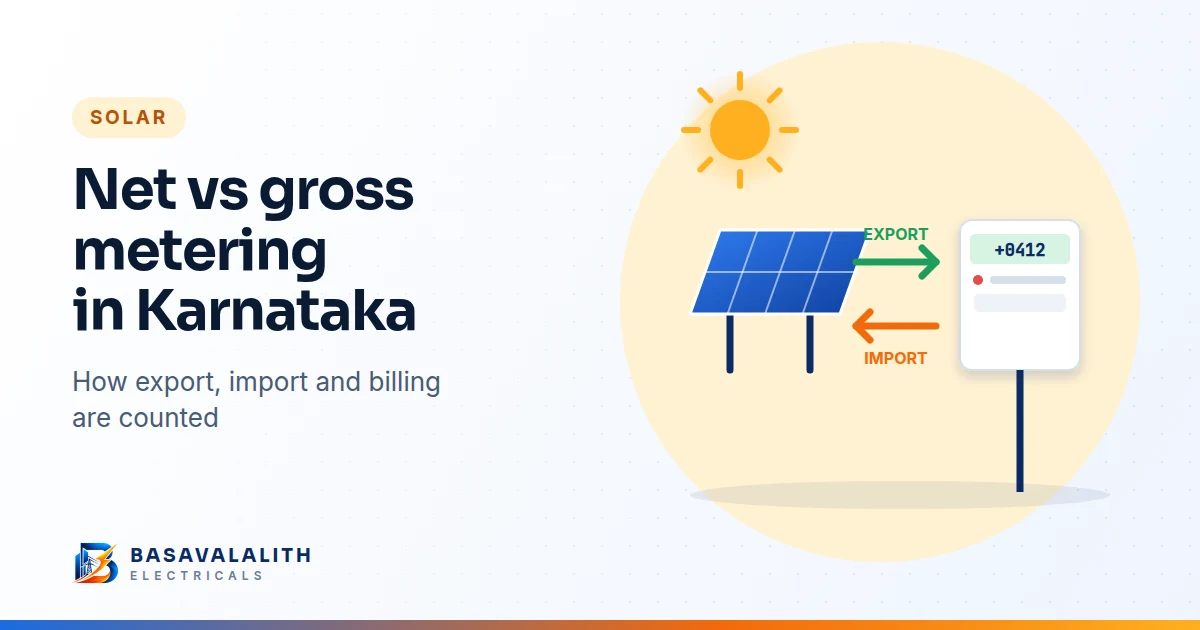
| Net metering | Solar units you export are set off against units you import. If exports exceed imports in the month, the surplus is bought at the KERC tariff. | All categories | 1 kW to sanctioned load or 1,000 kW, whichever is lower |
| Net billing | Imports are charged at your retail tariff; exports are credited at the (lower) solar tariff. The money values are netted. | All categories | 1 kW to sanctioned load |
| Gross metering | All solar generation is sold to the ESCOM at the solar tariff. All your consumption is billed at the normal tariff. | All categories | 1 kW to sanctioned load |
| Group net metering | One plant, surplus credited to your other connections in the same name and category, in a priority order you choose. | All categories | Minimum 5 kW |
| Virtual net metering | One plant shared by several consumers in the agreed ratio, e.g. flats in an apartment. | Domestic, apartments, housing societies, charitable and government buildings | Minimum 5 kW |
| Behind the meter | Solar for self-use only, with a reverse-power relay so nothing is exported. Nothing is paid for export. | All categories | Up to sanctioned load |
You can switch from net metering to another option only once in the life of the plant, so choose carefully.
Net or gross: which pays more for a home?
For almost every house the answer is net metering. The reason is simple arithmetic. Every unit you produce and use (or export and later take back) saves you the full retail rate: ₹5.80 energy charge in 2026-27, plus the per-unit surcharge and electricity tax on top. Under gross metering, every unit you produce is sold at the solar tariff instead, which is far lower:
| Category (plants commissioned from 25 Aug 2026) | Tariff for surplus / gross energy |
|---|---|
| Domestic 1–10 kW, without capital subsidy | ₹3.89 per unit |
| Domestic with PM Surya Ghar subsidy, 1–2 kW | ₹1.96 per unit |
| Domestic with PM Surya Ghar subsidy, above 2 kW up to 3 kW | ₹2.14 per unit |
| Domestic with PM Surya Ghar subsidy, above 3 kW | ₹2.58 per unit |
| Other consumers, DCR panels | ₹3.11 per unit |
| Other consumers, non-DCR panels | ₹2.34 per unit |
| Virtual / group net metering surplus | 75% of the "other consumers" tariff |
Notice what this means. If you take the PM Surya Ghar subsidy, the ESCOM pays you only about ₹2 for each surplus unit, because KERC deducts the subsidy when it fixes the tariff. So the money is in using your solar units, not in exporting them. Size the system to your own consumption, not to the roof area. Gross metering only makes sense where a consumer genuinely wants to sell all power, for example a building with very little load of its own.
Under net metering you still pay the monthly fixed charge, taxes and levies, even in a month when you export more than you use. Solar units can only offset units, not rupee charges. Domestic consumers up to 10 kW get a ₹25 per kW rebate on the fixed charge for installed solar.
Worked example: how a net-metered bill is settled
Here is how a domestic net-metered bill works in two different months, using the 2026-27 domestic energy charge of ₹5.80 and the solar tariffs in the table above. Fixed charges, surcharge and tax are left out to keep the arithmetic clear.
| Month A: summer, ACs running | Month B: holidays, house empty | |
|---|---|---|
| Units imported from the grid | 420 | 150 |
| Units exported by the plant | 300 | 250 |
| Net position | 120 units imported | 100 units surplus |
| Energy charge | 120 × ₹5.80 = ₹696 | Nil |
| Payment for surplus | Nil | 100 × ₹3.89 = ₹389 without subsidy, or 100 × ₹2.14 = ₹214 for a subsidised 2–3 kW plant |
Month A shows where solar earns its keep: each of the 300 exported units cancelled a unit that would have cost ₹5.80 plus charges. Month B shows the weak spot: the surplus units earn much less than they would have saved. This is why every guide on this site says to size the plant to your own use. You can test your own numbers with our electricity bill calculator.
Two things the example does not settle. We could not find a published rule on exactly how Gruha Jyothi free units are applied on a net-metered bill, so ask your subdivision before you rely on them. And if you are in a flat or a society, the same arithmetic applies to each participant's share under virtual net metering, but surplus is paid at 75% of the generic tariff.
Capacity limits, sanctioned load and the transformer
- Size is tied to sanctioned load. The plant cannot exceed your sanctioned load (converted at 0.85 kW per kVA for LT). For sanctioned loads up to 10 kW, a 10% tolerance on the DC panel capacity is allowed, as long as the inverter's AC rating does not exceed the sanctioned load. So with 5 kW sanctioned you can fit ten 540 W panels (5.4 kW DC) on a 5 kW inverter.
- Load enhancement up to 10 kW is automatic. Since a KERC order of 5 December 2024, if your sanctioned load is less than the solar capacity you want (up to 10 kW), the ESCOM enhances the load to match. You still pay the load enhancement charges and extra security deposit before commissioning. For more, see our load enhancement guide.
- Transformer hosting limit. Plants below 150 kW connect to the existing distribution transformer, and the total solar on that transformer cannot exceed 80% of its rating. If the transformer is full, the regulations say improvement works beyond the connection point are the ESCOM's job.
- Arrears block you. Consumers with pending dues are not eligible, unless the amount is under dispute and deposited.
Process and timelines (up to 150 kW)
For LT plants up to 150 kW there is no separate power purchase agreement. The terms are part of the online application, and submitting the application counts as approval to start work.
- 1Apply online on your ESCOM's DSPV portal (or pmsuryaghar.gov.in for subsidy)
Enter the account ID from the bill; the billing data is fetched automatically. Choose net, gross or net billing.
- 2Application = approval to start work
Non-subsidy applicants pay a registration and facilitation fee: ₹1,500 plus GST for 1–5 kW in the BESCOM SOP. Waived for PM Surya Ghar.
- 3Buy the smart meter(s) from an ESCOM-authorised outlet
One bidirectional smart meter if you already have a smart meter; otherwise a generation meter and a bidirectional meter.
- 4Install and upload the work completion report within 150 days
- ?Commissioned within 5 working days?Yes Billing starts within 30 daysNo Officer liable to pay you ₹1,000 a day; deemed generation benefit applies
- ✓First net-metered bill
If you delay commissioning by more than six months, the tariff becomes the lowest of the agreed tariff, the revised tariff, or 90% of the agreed tariff. Do not apply, lock a tariff and then sit on it.
Above 150 kW and up to 1,000 kW: acknowledgement in 3 working days, site feasibility in 10 working days, PPA within 5 working days of approval, then 150 days to complete. Larger plants may also need Electrical Inspectorate approval; see our CEIG approval guide.
| ESCOM | Districts (main) | Solar (DSPV) portal |
|---|---|---|
| BESCOM | Bengaluru Urban & Rural, Bengaluru South (Ramanagara), Kolar, Chikkaballapur, Tumakuru, Chitradurga, Davanagere | srtpv.bescom.org |
| MESCOM | Dakshina Kannada, Udupi, Shivamogga, Chikkamagaluru | srtpv.mesco.in |
| CESC Mysuru | Mysuru, Mandya, Hassan, Kodagu, Chamarajanagar | srtpv.cescmysore.org |
| HESCOM | Dharwad, Belagavi, Vijayapura, Bagalkot, Gadag, Haveri, Uttara Kannada | srtpv.hescom.co.in |
| GESCOM | Kalaburagi, Bidar, Raichur, Koppal, Ballari, Vijayanagara, Yadgir | gescomsrtpv.in |
What goes wrong at the counter
- Smart meter cost not budgeted. The meters are at the consumer's cost. Smart meter prices quoted in Karnataka (₹4,998 single-phase and ₹8,880 three-phase for new connections in 2025) were challenged in the High Court. Ask the outlet for the current price before you start. More in our meter guide.
- Inverter larger than sanctioned load. The DC tolerance is on panels only. An oversized inverter fails inspection.
- Name mismatch. The bill is still in a late parent's or previous owner's name. Do the name transfer first.
- Anti-islanding and isolator missing. The inverter must stop exporting when the grid fails, and the ESCOM can ask for a lockable manual isolating switch it can reach at any time.
- Behind-the-meter without telling the ESCOM. You must inform the ESCOM; if you don't within 3 months, there is a one-time penalty of ₹1,000 per kW.
- Future grid support charge. The regulations let KERC levy a "grid support charge" on solar generation in future. None has been fixed yet, but factor in that the rules can change over 25 years.
Solar rules in Karnataka changed in August 2026 and tariffs are revised every control period. This article explains how things work in practice. Before you sign or pay, confirm the current rule on pmsuryaghar.gov.in, your ESCOM's DSPV / SRTPV portal, the KERC website, or your subdivision office. The ESCOM helpline is 1912.
Questions
What is the net metering limit in Karnataka in 2026?
Under the KERC DSPV Regulations 2026, net metering is allowed from 1 kW up to the consumer's sanctioned load or 1,000 kW, whichever is lower, for all consumer categories.
How much does BESCOM pay for surplus solar units?
For plants commissioned from 25 August 2026, domestic 1–10 kW systems without subsidy get ₹3.89 per unit. With PM Surya Ghar subsidy it is ₹1.96 (1–2 kW), ₹2.14 (2–3 kW) and ₹2.58 (above 3 kW). The same KERC tariffs apply in all ESCOMs.
Is net metering better than gross metering for a house?
Usually yes. Under net metering each solar unit you use saves the full retail rate of ₹5.80 plus charges, while gross metering sells every unit at the much lower solar tariff.
Can shops and industries get net metering in Karnataka now?
Yes. The 2026 regulations allow net metering for all consumer categories up to sanctioned load or 1,000 kW. These limits apply until the state's total net-metered and shared solar reaches 3 GW.
Is a battery compulsory for rooftop solar above 10 kW?
No. The June 2026 draft proposed it, but the final regulations made batteries optional. KERC will review this after two years or at 3 GW of capacity.
Who pays for the net meter?
The consumer. The generation and bidirectional meters must be smart meters, installed by the ESCOM at the consumer's cost, usually bought from an ESCOM-authorised outlet.
Do I still pay fixed charges with net metering?
Yes. Exported units only offset imported units. Fixed charges, taxes and levies are payable every month, though domestic users up to 10 kW get a ₹25 per kW fixed-charge rebate for installed solar.
What happens if my solar exports more than I use in a month?
Under net metering the surplus units for that month are bought by the ESCOM at the KERC solar tariff, for example ₹3.89 for an unsubsidised domestic system or ₹1.96 to ₹2.58 with PM Surya Ghar subsidy.
Sources
Rules and figures in this article were checked against these sources on 30 Sep 2026. Schemes and tariffs change, so confirm with the official office before you act.
- KERC DSPV Regulations 2026 (gazette 24.08.2026)
- KERC DSPV tariff order dated 25.08.2026
- KERC order dated 05.12.2024 on load enhancement up to 10 kW and DC tolerance
- BESCOM common SOP for DSPV plants, 01.12.2025
- BESCOM DSPV / SRTPV portal and documents
- BESCOM circular 24.07.2026 on ALMM List-II window
- Energetica: KERC draft DSPV rules (June 2026)
- Vyqon: Karnataka finalises rooftop solar regulations (Sep 2026)
- KERC Tariff Order 2025 schedules, HRECS copy
- Deccan Herald: Karnataka High Court stays mandatory smart meters
Need this done for you?
We handle the electrical work and the ESCOM, KPTCL and CEIG liaisoning anywhere in Karnataka, with BESCOM, MESCOM, CESC, HESCOM and GESCOM. Email basavalalith.electricals@gmail.com or use the enquiry form.
Request a site visit