

What KERC's conditions of supply say
KERC's Conditions of Supply of Electricity classify low-tension supply like this:
| Supply | Who gets it |
|---|---|
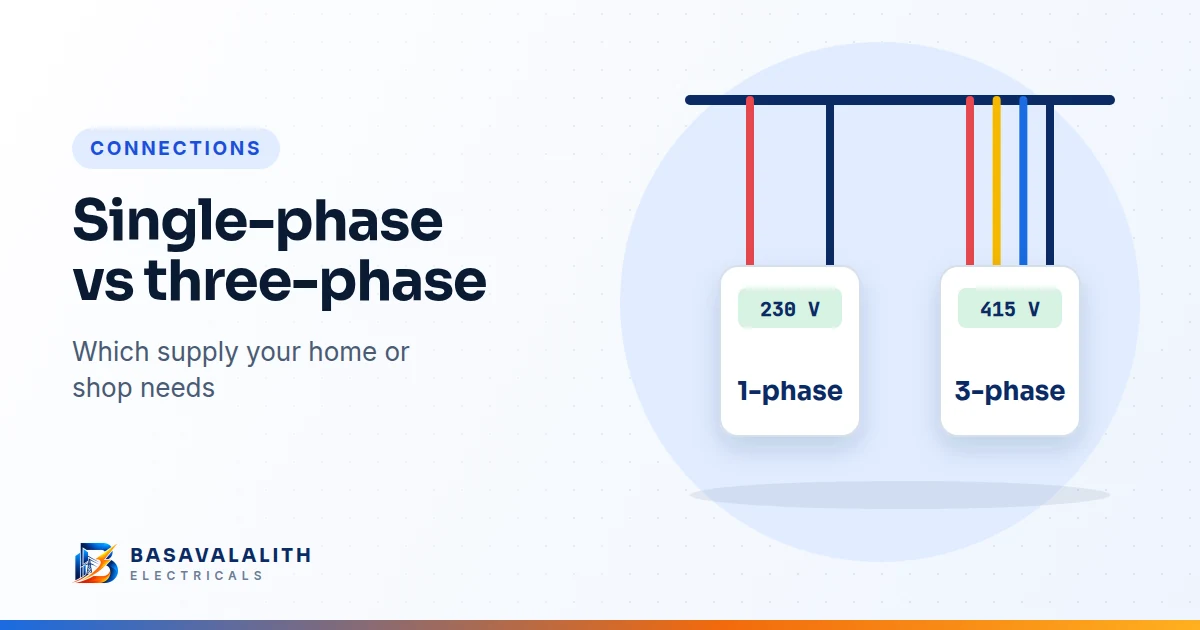
| 230 V single-phase | All installations other than motive power up to and including 5 kW sanctioned load; motive power up to 4 kW; single-phase motors not above 1 HP each |
| 400 V three-phase | Loads above that. The tariff order now allows LT supply where the requisitioned load is less than 150 kW / 201 HP |
| HT (11 kV and above) | Above the LT limit, or by choice for smaller loads (minimum contract demand 25 kVA) |
Two points people miss. First, you can ask for three-phase even below 5 kW if you intend to use three-phase equipment, and the ESCOM is to permit it. Second, KERC's August 2026 draft supply regulations keep single-phase "generally up to 5 kW". So the 5 kW line is not changing soon.
Add up your load honestly
Sanctioned load is what you agree with the ESCOM, in kW. Fixed charges are billed on it: ₹150 per kW per month for domestic supply in 2026-27. A smart or electronic meter also records your maximum demand, and penal charges apply if you keep exceeding the sanctioned load.
| Appliance | Typical rating |
|---|---|
| 1.5-ton inverter AC | 1.5–2.0 kW at full output |
| Storage geyser | 2.0–3.0 kW |
| Induction hob | 1.5–2.0 kW |
| Microwave / OTG | 1.2–2.0 kW |
| Borewell / sump pump (1 HP) | about 0.75 kW running, much more at start |
| Home EV charger | 3.3 kW or 7.4 kW |
A 3-bedroom house with two ACs, a geyser, a pump and normal lights and plugs easily reaches 6–8 kW. Not everything runs at once, but the ESCOM assesses load from what is installed, and a 7.4 kW EV charger alone is above the single-phase limit. See EV charger at home.
When to choose three-phase
- ?Is the total load you will use above 5 kW?Yes Three-phase is requiredNo Go to the next check
- ?Planning a 7.4 kW EV charger, three-phase pump or lift?Yes Choose three-phaseNo Go to the next check
- ?Low voltage in the evening on your street?Yes Three-phase spreads load and helps; ask the ESCOM tooNo Single-phase is fine for now
- ✓Leave space and conduits for three-phase later
Rooftop solar: under the PM Surya Ghar scheme most homes put in 2–3 kW, which works on single-phase. Larger systems are usually three-phase, and the ESCOM checks the inverter against the connection. See rooftop solar and PM Surya Ghar.
Building now? Even if you start on single-phase, run a 4-core service cable and a three-phase-ready distribution board. Converting later is then a meter change and a few hours of work, not chasing walls.
What three-phase costs
- Meter: the three-phase meter costs more. The smart meter prices quoted in BESCOM areas in 2025 were ₹4,998 for single-phase and ₹8,880 for three-phase. Both the price and the mandate were challenged in the Karnataka High Court, so check today's price at your subdivision.
- Deposits: the initial security deposit goes up with sanctioned load (about two months' estimated bill), so it is the extra kW that cost you, not the phase.
- Fixed charges: billed per kW, the same rate for single- and three-phase domestic supply. A higher sanctioned load means a higher fixed charge every month.
- Service line: a 4-wire service from the pole. Where the pole carries all three phases this is cheap. If the street has only single-phase LT, the ESCOM may need to extend a phase, and that can add cost and time.
- Inside wiring: a three-phase DB with a 4-pole isolator or MCB, a 4-pole RCCB, and re-grouping of circuits by the contractor.
For a typical house moving from 5 kW single-phase to 8 kW three-phase, the recurring cost is the extra fixed charge on 3 kW, about ₹450 a month at the 2026-27 domestic rate, plus electricity tax. The one-time cost is the meter, the extra deposit and your contractor's DB work. Units consumed don't change just because you have three phases. Your bill only goes up if you actually use more.
How to convert single-phase to three-phase
Conversion is a load enhancement application. The full process is in our load enhancement guide; the outline:
- Your contractor rewires the DB for three phases and gives an updated test report and load list.
- Apply to your ESCOM (online or at the subdivision) for additional load, with your RR / account number, ID and the test report.
- The section engineer inspects, then issues a demand note for the extra deposit and the three-phase meter.
- After you pay, the ESCOM replaces the meter and connects the 4-wire service.
KERC's standards of performance, as summarised in a Forum of Regulators comparison, give the ESCOM 30 days from payment to convert LT single-phase to three-phase or back. If it takes longer, see ESCOM delays and compensation.
Mistakes to avoid when you switch to three-phase
- Applying before the wiring is ready. The ESCOM can change the meter in a few hours, but if your DB is still single-phase the house keeps running on one phase. Get the DB rewired and tested first.
- Keeping the old two-pole isolator and RCCB. A three-phase house needs a four-pole isolator, and either a four-pole RCCB or separate RCCBs for each phase group. See MCB, RCCB and RCBO explained.
- Sanctioning far more load than you need. Fixed charges are billed per kW every month. Ask for the load you will really install plus a sensible margin, not the largest figure on the form.
- Forgetting the other meters. If rented floors have their own meters, each is a separate connection with its own sanctioned load and its own application. See separate meters for rented portions.
- Reusing a tired service cable. An old 2-core cable, or an aluminium one with corroded ends, should be replaced with a 4-core cable of the right size when the meter changes.
- Forgetting the solar. If you have rooftop solar on a single-phase inverter, tell the ESCOM when you apply and ask how the net meter will be handled. Our net metering guide explains the rules.
Farms, workshops and rural houses
Outside the cities, the choice is less about appliances and more about what the line on your street can carry.
- Pumps: single-phase motors are limited to 1 HP each under the conditions of supply. A borewell pump of 3 HP or more needs a three-phase connection. Irrigation pump sets are a separate IP-set category with their own rules and supply hours. See farmers' IP set electricity.
- Mixed feeders: in many villages the three-phase supply on rural feeders is scheduled for set hours, and only single-phase is available the rest of the time. A three-phase house there must still run its essential lights and fans on single-phase. Keep those circuits on the phase that stays live, and ask the section office which one that is.
- Small workshops: a flour mill, welding set or lathe at home is not domestic load. It needs the right tariff category, usually LT industrial or commercial, and often three-phase. Running it on a domestic connection can be treated as misuse and billed at a higher rate.
- Long service lines: a farmhouse 200 m from the nearest pole will see voltage drop on single-phase long before it reaches 5 kW. A three-phase service, or a pole extension, solves both problems.
In all of these cases, call the section officer before you buy the motor or machine. Ask which phases the pole outside carries and how loaded the nearest transformer is. If the transformer is already overloaded, a new connection or load enhancement can be held up until it is upgraded.
If your voltage is low, register a complaint on 1912. KERC's standards give the ESCOM 7 days to fix a voltage problem that needs no network work. Running a cable from a neighbour's phase, or hooking a second phase from the pole, is unauthorised and dangerous.
Phase balancing: the part most houses get wrong
A three-phase connection gives you three 230 V supplies. If your electrician puts the ACs, geyser and kitchen on one phase and the lights on the other two, you have paid for three-phase and still trip the MCB on one phase. Worse, a heavily unbalanced load causes high neutral current and voltage drop.
- List every heavy load and spread them: for example, AC 1 and the geyser on R, AC 2 and the induction hob on Y, the pump, oven and EV plug on B.
- Keep each room's sockets on one phase. This avoids 400 V between two sockets close to each other.
- Use a three-phase motor for a pump above 1 HP, so its load sits evenly on all three phases.
- Ask for a clamp-meter reading on each phase with the house running normally. The currents should be roughly similar.
- Don't use a phase selector to dump everything on the "good" phase when one phase is low. Report low voltage to 1912.
KERC regulations, tariff orders and ESCOM circulars change from time to time, and a new consolidated Electricity Supply Regulations draft was published by KERC in August 2026. Before you act, confirm the current rule with your ESCOM subdivision office (BESCOM, MESCOM, CESC Mysuru, HESCOM or GESCOM), on kerc.karnataka.gov.in, or on the helpline 1912.
Questions
What is the maximum load on single-phase supply in Karnataka?
Under KERC's conditions of supply, single-phase supply is for installations up to and including 5 kW sanctioned load (4 kW for motive power). Above that, three-phase is required.
Can I get three-phase for a load below 5 kW?
Yes. The conditions of supply say the ESCOM shall permit three-phase for a lower load if the consumer intends to use three-phase equipment.
Is the fixed charge higher for three-phase?
Domestic fixed charges are billed per kW of sanctioned load, ₹150 per kW per month in 2026-27. The phase does not change the rate, but the higher sanctioned load does.
How long does single-phase to three-phase conversion take?
KERC's standards give 30 days from the date you pay the charges. The wiring changes on your side should be ready before you apply.
Do I need three-phase for a 7.4 kW EV charger?
Yes in practice, because a 7.4 kW charger alone is above the 5 kW single-phase limit. A 3.3 kW charger can work on single-phase if the rest of your load allows.
Why does my three-phase MCB still trip?
Usually the loads are not balanced and most heavy appliances sit on one phase. A contractor can re-group circuits so each phase carries a similar load.
Sources
Rules and figures in this article were checked against these sources on 30 Sep 2026. Schemes and tariffs change, so confirm with the official office before you act.
- KERC Conditions of Supply of Electricity, clause 3.02 (GESCOM copy)
- KERC Tariff Order 2025, tariff schedule, HRECS copy (LT limit 150 kW, LT-1 rates)
- SolarQuarter: KERC draft unified Electricity Supply Regulations 2026
- Forum of Regulators / IIT Kanpur: presentation on Standards of Performance (state comparison)
- Deccan Herald: Karnataka High Court stays mandatory installation of smart meters
- Deccan Herald: HESCOM plans a 6-hour three-phase power supply (rural feeders)
Need this done for you?
We handle the electrical work and the ESCOM, KPTCL and CEIG liaisoning anywhere in Karnataka, with BESCOM, MESCOM, CESC, HESCOM and GESCOM. Email basavalalith.electricals@gmail.com or use the enquiry form.
Request a site visit