

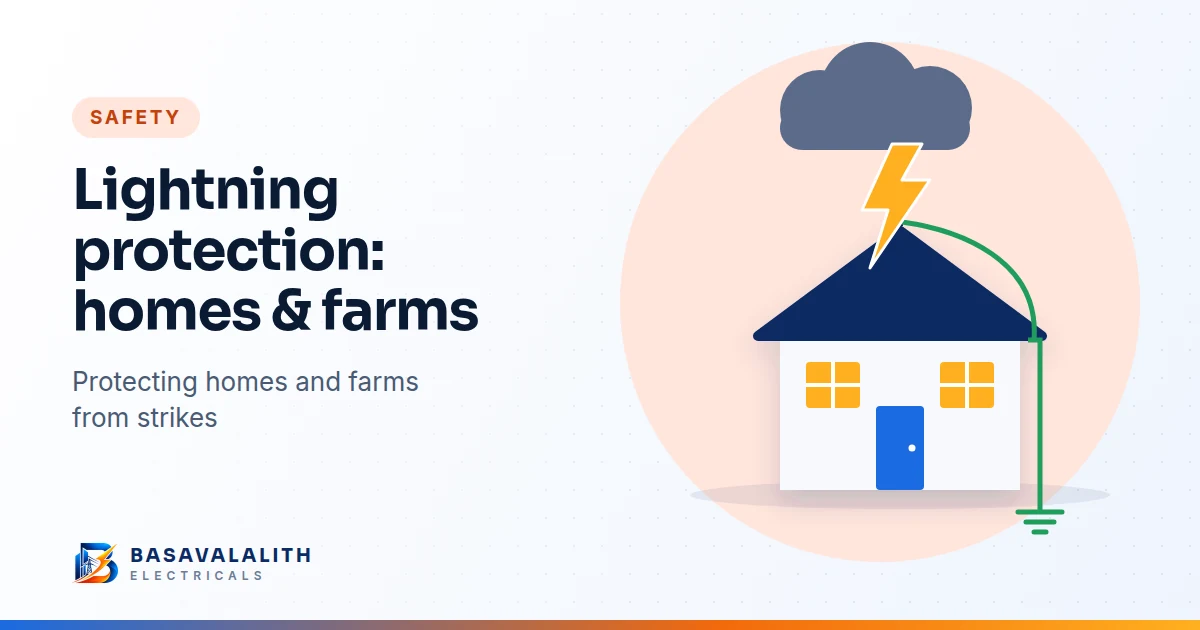
Lightning deaths in Karnataka
Data reported by Deccan Herald on 28 September 2026, from the Revenue department (Disaster Management) and KSNDMC:
- 36 people had died from lightning in 2026 by late September, more than half of the 70 rain-related deaths that year.
- In 2025-26, 64 of 147 rain-related deaths were from lightning.
- Since 2022-23, 340 of 779 rain-related deaths were lightning strikes.
- KSNDMC data shows 1,190 lightning deaths between 2011 and 2026. Most of the dead were farmers working in their fields.
- Over the last 15 years, Belagavi has the most deaths, followed by Kalaburagi, Vijayapura, Bidar, Hassan, Koppal, Haveri, Yadgir, Tumakuru, Gadag and Raichur.
It is not only a northern problem. Hassan and Tumakuru are on the list, and deaths are reported every year in Mysuru, Mandya and the coastal and Malnad districts. The pre-monsoon months of April and May, with sudden thunderstorms, are especially dangerous.
Get the warning: Sidilu, Damini and Sachet
- Sidilu is KSNDMC's lightning app. Karnataka has a network of 11 lightning detection sensor stations, and alerts are sent about 45 minutes ahead for the location. Alerts also go out by SMS, which matters for people without smartphones.
- Damini, from IITM Pune under the Ministry of Earth Sciences, shows lightning activity near your GPS location across India.
- Sachet, from NDMA, carries IMD and State alerts for thunderstorms, heavy rain and other hazards, in Indian languages.
The KSDMA Commissioner told DH that deaths have fallen since the warning system came in, but that most victims are in fields where the network is weak or they have no phone. Install the app on the phone of whoever goes to the field, and set it to sound, not just notify. A message read after the storm saves nobody.
IS/IEC 62305: how buildings are protected
BIS has adopted the IEC lightning standard as IS/IEC 62305 in four parts, and the National Building Code 2016 refers to it. CEA Regulation 38 also requires lightning protection as per the relevant standards for buildings above 15 m and for hospitals, hotels, schools, places of worship and other public buildings.
| Part | Covers | What it means for you |
|---|---|---|
| 62305-1 | General principles | Why and how lightning causes damage |
| 62305-2 | Risk assessment | Decides whether your structure needs a system, and what level |
| 62305-3 | Physical protection | Air terminals, down conductors, earth termination |
| 62305-4 | Electrical and electronic systems | Surge protection inside the building |
An ordinary low house in a town surrounded by taller buildings may come out as low risk. An isolated farmhouse, a hilltop house, a tall water tank, a poultry shed on open land or a building with a mobile tower nearby usually needs protection. The risk assessment, not a salesman, should decide.
Lightning arrester vs surge protector
| Lightning protection system ("arrester" on the roof) | Surge protective device (SPD) in the DB | |
|---|---|---|
| Protects | The structure and people inside from a direct strike: fire, cracked slabs, side flashes | Wiring and appliances from voltage surges coming in on the supply or induced by nearby strikes |
| Parts | Air terminals on the highest points, down conductors on the outside, dedicated earth pits | Type 1 at the service entrance where a direct strike is possible; Type 2 at the distribution board; Type 3 near sensitive equipment |
| Standard | IS/IEC 62305-3 | IS/IEC 62305-4 and IEC 61643 series |
You usually need both. A roof arrester without an SPD protects the building but still lets a surge destroy the TV, inverter and solar inverter. An SPD alone does nothing against a direct strike. If you have rooftop solar, the inverter needs SPDs on the DC and AC side; see our rooftop solar guide.
Some sellers promise that one special air terminal protects a radius of 100 m or more. IS/IEC 62305 does not recognise such enhanced radius claims. Design to the standard, with the protection level from the risk assessment.
Earthing for the lightning system
- Give the lightning protection system its own earth pits, generally at least two for a house, at the foot of the down conductors and away from the walls.
- Bond the lightning earth to the electrical earth of the house below ground or at a main earthing bar. IS/IEC 62305 requires equipotential bonding; separate, unbonded earths can flash over to each other during a strike. CEA Regulation 43 also requires protective equipotential bonding in every building.
- Run down conductors in straight paths on the outside of the building, with no sharp bends and no loops. Do not run them inside along the electrical conduits.
- Test the earth resistance after installation and before each monsoon, and keep the readings. See the earthing and testing checklist.
- Bond metal water tanks, solar structures and dish antennas on the roof to the lightning system.
Common mistakes we find on site
- Arrester on the roof, earth wire into the nearest electrical pit. The lightning current then enters the house earth at one point, raising it to a high voltage and damaging appliances. Use dedicated pits and bond them properly.
- Down conductor run inside a wall or along the DB. A strike can side-flash from the conductor to the wiring. Keep it outside and straight.
- Thin wire as down conductor. The standard sets minimum sizes for air terminals, conductors and earth electrodes. A strand of house wire is not a down conductor.
- Never tested. The pit was dug once and forgotten. Joints corrode and soil dries; test before each monsoon.
- Solar added later without bonding. A new rooftop structure becomes the tallest metal on the roof. Bond it into the lightning system and fit SPDs.
- SPD with no back-up protection. An SPD that fails short needs its own MCB or fuse ahead of it, and its status window should be checked after storms.
Getting a lightning protection system installed
Ask for these when you get a quote, and compare quotes on the same basis:
The cost depends on the roof area, height, number of down conductors and earth pits, and the SPDs needed, so a quote by "per arrester" alone tells you little. For buildings above 15 m and public buildings, confirm the requirement with the Electrical Inspectorate; see CEIG approval and inspection. On farms, a solar pump structure in an open field is often the tallest metal around; see PM-KUSUM solar pumps, and for a house on farmland, farmhouse electricity connections. The difference between SPDs and RCCBs is explained in MCB, RCCB and RCBO explained.
During a thunderstorm
Farmers and people in open fields
Most lightning victims in Karnataka are in fields. What helps:
- Watch the sky and the app. Leave the field when the alert comes or the first thunder is heard, not when the rain starts.
- Do not shelter under an isolated tree. It is the most common way farmers and grazers are killed. Cattle tied under a tree die for the same reason.
- Get off tractors and away from pump sheds with metal roofs that are not earthed, wire fences and water. Do not hold sickles, umbrellas or iron tools above your head.
- Groups should spread out, so one strike does not injure everyone.
- If there is truly no shelter, crouch low on the balls of your feet, feet together, head down and hands over ears. Treat this as a last resort: weather services abroad stopped recommending it because it gives little real protection. Getting to shelter early is what saves lives.
- A farmhouse, pump house or cattle shed on open land can be fitted with a lightning protection system to IS/IEC 62305. That gives the family and animals a safe place to run to.
Families of people killed by lightning get ex gratia from the State. In 2025 the Chief Minister said ₹5 lakh was paid for each rain-related death. Ask the tahsildar; it is a revenue department payment, separate from ESCOM compensation, which applies to accidents on power lines. See electrical accident compensation and our monsoon safety guide.
Install Sidilu from KSNDMC and follow district alerts. For lightning protection of a building, ask for a design to IS/IEC 62305 with a risk assessment, from a licensed contractor, and for tall or public buildings confirm the requirement with the Electrical Inspectorate. Ex gratia for lightning deaths is handled by the tahsildar's office.
Questions
How many people die from lightning in Karnataka?
KSNDMC data reported in September 2026 shows 1,190 lightning deaths between 2011 and 2026. In 2025-26, 64 of 147 rain-related deaths were from lightning, and 36 people had died from lightning in 2026 by late September.
Which app gives lightning alerts in Karnataka?
Sidilu, developed by KSNDMC, gives location-based alerts about 45 minutes ahead. Damini from IITM Pune and Sachet from NDMA also carry lightning and thunderstorm alerts.
What is the difference between a lightning arrester and a surge protector?
A lightning protection system on the roof takes a direct strike safely to earth and protects the building. A surge protective device in the DB protects wiring and appliances from voltage surges. Most buildings at risk need both.
Does my house need a lightning arrester?
It depends on a risk assessment under IS/IEC 62305-2. Isolated, tall or hilltop buildings, farmhouses and buildings with tall water tanks are usually at higher risk.
Is it safe to stand under a tree during lightning?
No. Sheltering under an isolated tree is one of the most common causes of lightning deaths among farmers and grazers.
What compensation is given for death by lightning in Karnataka?
The State pays ex gratia through the revenue department. In 2025 the Chief Minister said ₹5 lakh was paid for each rain-related death. Contact the tahsildar's office.
Sources
Rules and figures in this article were checked against these sources on 30 Sep 2026. Schemes and tariffs change, so confirm with the official office before you act.
- 70 lives lost in rain-related incidents in Karnataka this year (Deccan Herald, 28 Sep 2026)
- Year-ender 2025: extreme weather events in Karnataka (Deccan Herald)
- Deccan Herald, May 2025: seven killed by lightning during heavy rain
- Sidilu app to alert citizens before lightning
- Damini: Lightning Alert (Google Play)
- All about the DAMINI app for lightning alerts (India TV)
- IEC 62305 and IEC 62561 standards explained (Axis India)
- SPD Type 1, 2 and 3 under IEC 61643 (Instrumentation Blog)
- CEA (Measures relating to Safety and Electric Supply) Regulations, 2023 - Gazette
- Forget the lightning crouch, weather experts say (Yahoo News)
Need this done for you?
We handle the electrical work and the ESCOM, KPTCL and CEIG liaisoning anywhere in Karnataka, with BESCOM, MESCOM, CESC, HESCOM and GESCOM. Email basavalalith.electricals@gmail.com or use the enquiry form.
Request a site visit